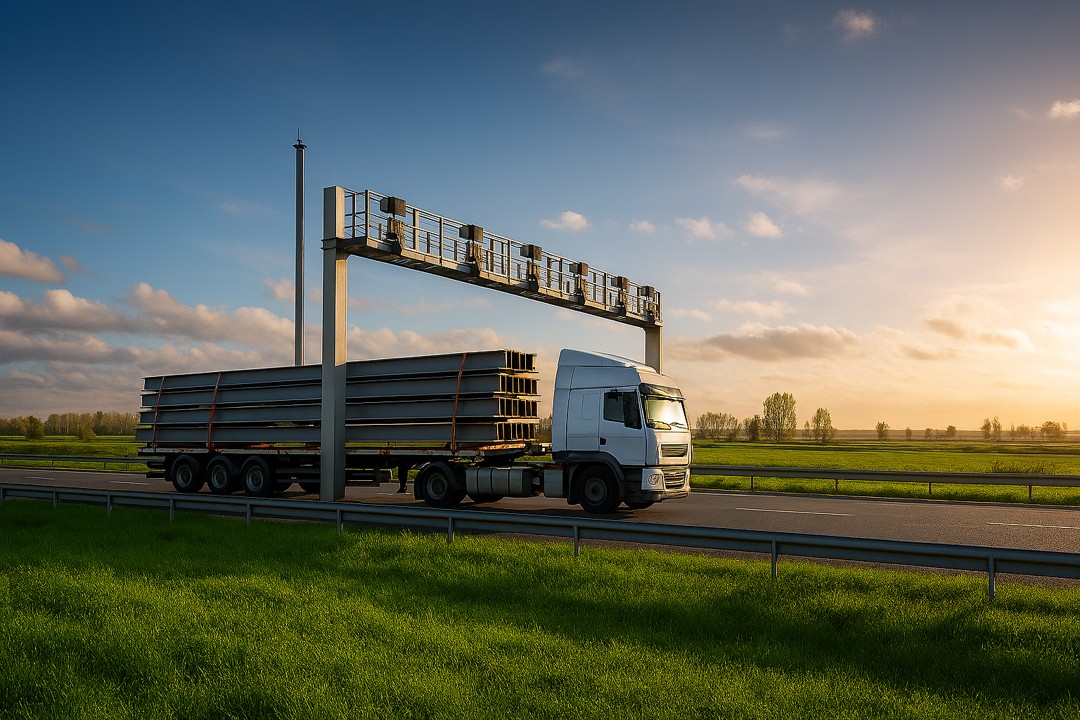
Since 1 April 2016, Belgium has applied a kilometre-based road charge for trucks weighing more than 3.5 tonnes. The charge is organised by Viapass, the interregional entity that coordinates cooperation between Flanders, Wallonia and the Brussels-Capital Region.
Ten years after its introduction, it is interesting to examine how this charge has evolved and what impact it has today on transport and distribution costs. For sectors where goods are transported over longer distances on a daily basis, such as the steel trade and construction, the kilometre charge plays an increasingly visible role in logistics costs.
At the time of its introduction, the impact of the kilometre charge was already analysed. A sample calculation from 2016 showed that a heavy truck (>32 tonnes, Euro 4) on a 300-kilometre route with two delivery points generated an additional cost of approximately €22.35 per delivery.
Tariff evolution since 2016
Over the past ten years, the tariffs have been adjusted several times. When applying the same parameters as in the 2016 simulation, the current cost per delivery (tariffs on 01/01/2026) is as follows:
Region | Cost per delivery | Change vs. 2016 |
|---|---|---|
Flanders | €34.95 | +56% |
Wallonia (excl. VAT) | €33.30 | +49% |
Brussels – motorway | €29.40 | +32% |
Brussels – urban area | €46.50 | +108% |
For companies that have invested in a cleaner truck fleet in recent years with Euro 5 and Euro 6 vehicles, the tariffs are slightly lower. For Euro-5 vehicles, the cost ranges between €27 and €44 per delivery, or +21% to almost +97% higher than in 2016. For Euro-6 vehicles, the range is between €25 and €40, or +13% to +79%.
Actual logistics impact
In practice, many products are transported over more than one leg. Materials may first be delivered to a warehouse and then transported onwards to the customer or construction site.
This means the kilometre charge is often paid multiple times within the logistics chain. When this double transport movement is considered, the picture becomes as follows:
Region | Cost per delivery | Double impact |
|---|---|---|
Flanders | €34.95 | €69.90 |
Wallonia | €33.30 | €66.60 |
Brussels – motorway | €29.40 | €58.80 |
Brussels – urban area | €46.50 | €93.00 |
What does this mean in practice?
Ten years after the introduction of the kilometre charge, several observations can be made:
- The cost per delivery in most regions today lies between €30 and €35.
- When the full logistics chain is considered, the impact can rise to around €70 per delivery, excluding the Brussels urban area.
- The currently applied price of approximately €26 per delivery is structurally below the actual logistics cost.
For sectors where transport is an essential part of operations, the kilometre charge therefore remains an important factor in the overall cost structure.