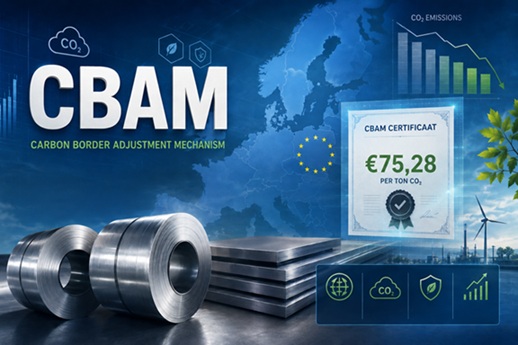
The European Commission has published the CBAM certificate price for the second quarter of 2026 at €75.28 per tonne of CO₂. Although importers will only be required to purchase CBAM certificates from February 2027 onwards, this announcement marks an important step in the transition from the reporting phase to the financial implementation of the Carbon Border Adjustment Mechanism (CBAM).
The CBAM certificate price is directly linked to the average auction price of allowances under the EU Emissions Trading System (EU ETS). The prices published during 2026 will determine the carbon costs associated with CBAM goods already being imported today. For steel importers and distributors, the financial implications of CBAM are therefore becoming increasingly tangible.
However, the ultimate cost will depend on more than the carbon price alone. The quality of emissions data, monitoring systems and timely verification will be equally important. Companies able to rely on verified actual emissions are likely to face significantly lower CBAM costs than those forced to use the default values provided for under the legislation.
Verification capacity raises concerns
These issues were recently discussed during a meeting between EUROMETAL and DG TAXUD, the European Commission's Directorate-General responsible for implementing CBAM.
EUROMETAL expressed serious concerns regarding the availability of accredited CBAM verifiers. According to information received from several certification bodies, many accreditation procedures are unlikely to be completed before the end of 2026 or early 2027. Only then will verifiers be able to start accepting assignments and verifying emissions data for the thousands of production installations worldwide that fall within the scope of CBAM.
As a result, importers may not have access to verified emissions data when they first become subject to the obligation to purchase CBAM certificates.
EUROMETAL warned that, in such circumstances, companies could be required to purchase certificates based on conservative default values. Since these values are often significantly higher than actual emissions for many steel products, this could create substantial additional financing requirements and place considerable pressure on companies' cash flow.
The association therefore proposed allowing importers, during an initial transition period, to calculate their certificate obligations using self-assessed, mill-reported or pre-verified actual emissions, with any differences being reconciled once the official verification has been completed.
DG TAXUD acknowledged these concerns but pointed out that the current CBAM Regulation does not allow any exemption from the verification requirement. The Commission is nevertheless working closely with accreditation bodies to expand verification capacity as quickly as possible.
Practical implementation still requires attention
The meeting also highlighted several operational issues.
Among them is the uncertainty surrounding the readiness of the European CBAM certificate purchasing portal. According to DG TAXUD, the objective remains to have the system operational during the first quarter of 2027.
EUROMETAL also reported practical difficulties with the CBAM Declarant Portal, particularly regarding user roles and authorisation procedures.
Another important issue concerns the different customs procedures applied by Member States for the administration of EU steel tariff quotas. While some Member States allow importers to know whether goods fall within quota before releasing them for free circulation, customs clearance in countries such as Belgium is generally processed in a single automated step. This may expose companies to the unexpected application of the 50% out-of-quota duty when quotas have already been exhausted.
EUROMETAL is therefore calling for a more harmonised approach across the European Union to ensure a level playing field for steel importers in all Member States.
Preparation is becoming increasingly important
The publication of the first CBAM certificate prices confirms that the transition towards the payment phase is approaching rapidly. For Belgian steel traders, adequate preparation is becoming increasingly important.
In addition to monitoring developments in carbon prices, companies should focus on obtaining reliable emissions data, strengthening cooperation with suppliers and ensuring timely verification of emissions information. The coming months are also expected to bring greater clarity on the upcoming ETS reform and possible adjustments to the practical implementation of CBAM.