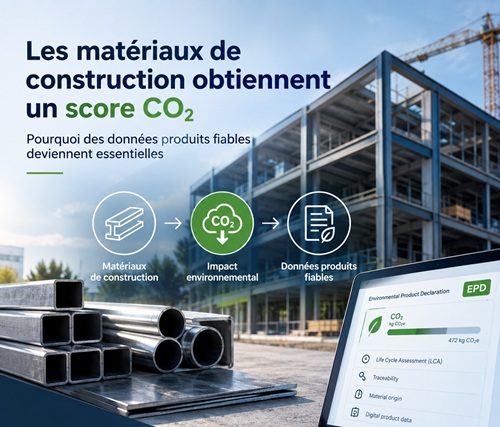
The European construction sector is undergoing an important change. A building’s climate impact is increasingly determined by more than just its energy consumption during the use phase. The environmental impact of the construction materials used is also receiving greater attention.
At the BENOR Seminar 2026, it was explained how the revised European Energy Performance of Buildings Directive (EPBD) is accelerating this development. For the metal and steel trade, this means that reliable product information, environmental data and traceability are becoming increasingly important.
From energy performance to the full life cycle
European legislation is shifting its focus towards the full life cycle of a building. It is no longer only the energy consumed during the use phase that matters, but also the emissions associated with the production, transport, processing and end-of-life of construction materials.
For materials such as steel and aluminium, this is an important development. Their environmental impact contributes to the overall climate impact of a building. As a result, material choices will increasingly depend not only on price and technical performance, but also on the environmental information available.
This new approach will become more concrete in the coming years. From 2028, life-cycle impact calculations will be mandatory for larger new buildings. From 2030, this requirement will apply to all new buildings.
Reliable product data are becoming crucial
A life-cycle calculation is only as reliable as the data on which it is based. High-quality product data are therefore becoming an increasingly important link in the construction value chain.
Environmental Product Declarations (EPDs) play an important role in this respect. They provide standardised information on the environmental impact of products and can be used in Life Cycle Assessments (LCAs).
For producers and distributors, this means that product information is becoming more than a technical datasheet. Data on origin, performance, environmental impact and traceability may increasingly be relevant for design choices, tenders and sustainability reporting.
The question will therefore not only be which products are available, but also what reliable information is available about those products.
The metal trade is also affected
Although the new legislation is primarily visible to building owners, architects, designers and contractors, its impact will be felt throughout the construction value chain.
For the metal and steel trade, EPDs, Life Cycle Assessments (LCAs),traceability and digital product data will become increasingly important. Trading companies will increasingly need to be able to collect, assess and pass on product information to customers and other partners in the value chain.
Digitalisation also plays an important role. European initiatives involving databases and Digital Product Passports aim to make product information easier to exchange digitally. Data therefore need not only to be available, but also to be reliable, comparable and digitally usable.
The transition towards a construction sector in which environmental impact and product data play a central role naturally brings challenges. At the same time, it creates new opportunities for companies that are already investing in knowledge and high-quality product data. As environmental information plays an increasingly important role in design and purchasing decisions, effective management of product data can become a competitive advantage.
=> Discover what the new legislation means for product data, EPDs, LCA calculations, TOTEM and the future of the metal trade. The full background note “Construction materials get a CO₂ score” is available on request to Belmetal members in Dutch and French.