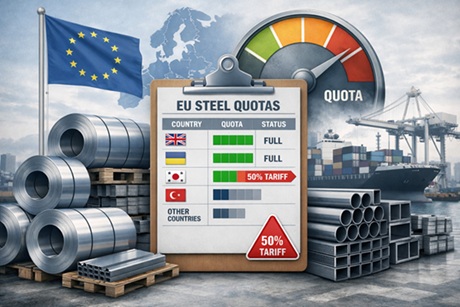
From 1 July 2026, the new European steel import quota system officially enters into force. On 29 June, the European Commission published the implementing regulation setting the available import quotas by country and product category, making the EU's new steel market protection mechanism fully operational.
The new regime replaces the existing safeguard measures and reduces the total volume of steel that can be imported into the European Union duty-free to 18.3 million tonnes per year. Once a quota has been exhausted, a 50% import duty applies. The measure aims to strengthen the protection of the European steel industry against persistent global overcapacity and trade diversion resulting from international trade measures.
Agreements reached with twelve trading partners
Ahead of the publication, the European Commission held intensive negotiations with several countries that have free trade agreements with the EU. As previously reported by Politico and now confirmed by the final quota allocation, twelve FTA partners received more favourable treatment than initially foreseen.
Countries including the United Kingdom, Ukraine, Switzerland, Serbia, North Macedonia, South Korea, Türkiye and other FTA partners will retain a larger share of their historical access to the European market. According to the Commission, this approach reflects the need to safeguard security of supply, honour existing trade agreements and maintain diversified sources of supply. Ukraine also benefits from a dedicated preferential regime in view of its exceptional security situation.
What changes for Belgian steel traders?
For Belgian steel traders, the main implication is that the availability of imported steel will increasingly depend on country-specific quotas and on how quickly these quotas are exhausted during each quarter.
The implementing regulation introduces:
- country-specific quotas for major exporting countries;
- separate quotas for Free Trade Agreement (FTA) partners;
- residual quotas ("Other countries");
- additional FTA quotas that become available once country-specific quotas have been exhausted.
Importers will therefore need to align their purchasing strategies even more closely with quarterly quota openings and the available volumes by country of origin.
Greater predictability, but also greater complexity
According to the Commission, the new allocation is based on objective criteria, including historical import volumes (2022-2024),WTO rules, existing free trade agreements, security of supply and the need for diversified sourcing. At the same time, the system is considerably more complex than the previous safeguard regime, as several quota categories now coexist depending on origin and trade status.
For many Belgian distributors, careful monitoring of quota utilisation will be essential to avoid unexpected 50% import duties.
Impact on the Belgian market
Belgium is one of Europe's leading hubs for steel distribution and processing. As a result, the new quotas will directly influence:
- product availability;
- sourcing strategies by country of origin;
- price developments on the European market;
- delivery lead times throughout the year.
The new quota system provides greater predictability, but also increased complexity. The coming quarters will determine how quickly quotas are exhausted and how companies will need to adapt their purchasing strategies.