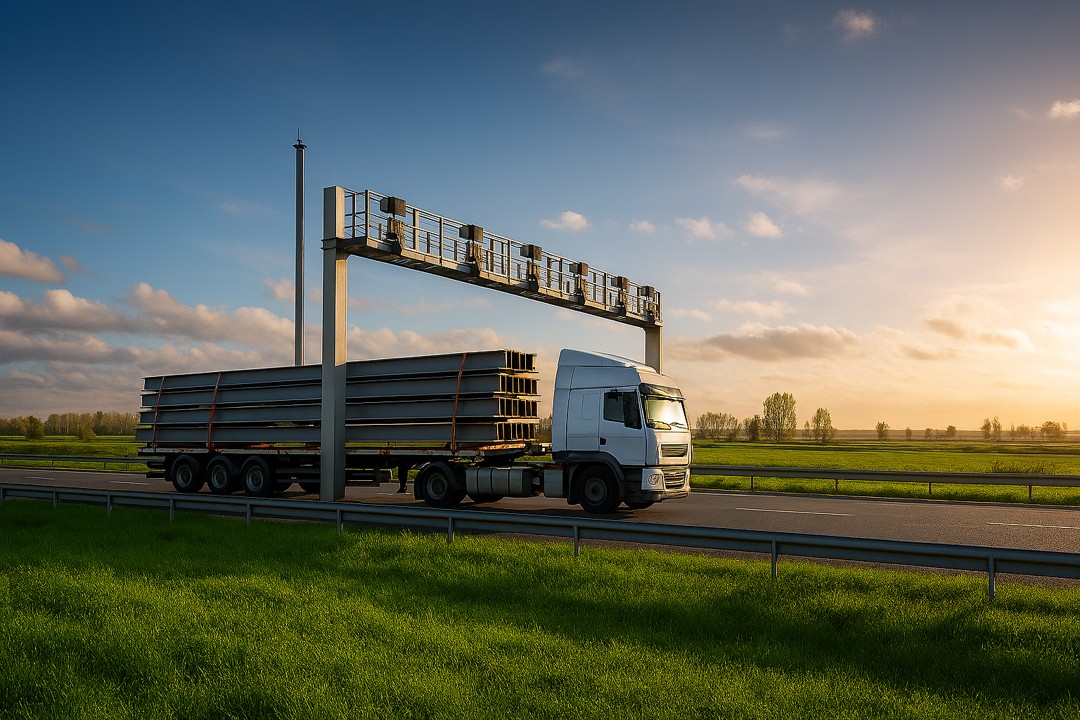
Ten years after the introduction of Belgium’s kilometre charge, the road transport sector is facing another significant change. From 1 July 2026, Flanders will introduce an additional CO₂-related surcharge on top of the existing kilometre charge for vehicles over 3.5 tonnes.
As a result, vehicle CO₂ emissions will become an additional factor in determining road charging costs, alongside vehicle weight, Euro emission standard and the region where the vehicle operates.
For steel traders, where transport is a key part of daily operations, understanding the impact of this change is essential.
From Euro standards to CO₂ emission classes
Until now, kilometre charges have been calculated based on the vehicle’s maximum authorised weight, its Euro emission standard and the region in which it travels.
From 1 July 2026, Flanders will add a fourth parameter: the CO₂ emission class.
Five emission classes will be used. The lower a vehicle’s CO₂ emissions, the more favourable the surcharge. Class 5 is reserved for zero-emission vehicles.
The measure stems from European legislation aimed at encouraging investment in cleaner and more energy-efficient truck fleets.
Flanders adopts CO₂ differentiation, Wallonia does not
An important aspect of the reform is that the new CO₂ surcharge will initially apply only in Flanders.
In Brussels, changes are limited to a tariff indexation, while Wallonia has opted for a general tariff adjustment without introducing a separate CO₂ component.
This creates, for the first time, a clear difference in how Belgium’s three regions are developing their kilometre charging systems.
Every truck must receive a CO₂ emission class
All vehicles subject to the kilometre charge must be registered with a CO₂ emission class. Viapass provides a dedicated calculator to determine the correct classification.
The classification is based on factors such as the vehicle’s first registration date, vehicle subgroup and specific CO₂ emissions.
Trucks first registered before 1 July 2019 will automatically be assigned to CO₂ emission class 1, the least favourable category.
Impact on transport costs
In our recent article marking ten years of the kilometre charge, we highlighted that delivery costs are already significantly higher than when the system was introduced in 2016.
The introduction of the CO₂ surcharge will further increase the gap between older and newer vehicles. Transport companies operating modern fleets will be relatively better positioned than those relying on older trucks.
For steel traders, this is particularly relevant as transport costs are often directly reflected in delivery prices. Additional costs per kilometre can have a noticeable impact, especially for smaller orders, frequent site deliveries and long-distance distribution.
Preparing for the change
Although the CO₂ surcharge currently applies only in Flanders, all affected vehicles must have their CO₂ emission class registered.
Steel traders operating their own vehicles or working closely with transport providers are therefore advised to verify the classification of the vehicles involved as soon as possible. This will help them anticipate potential cost increases and adapt their logistics planning accordingly.