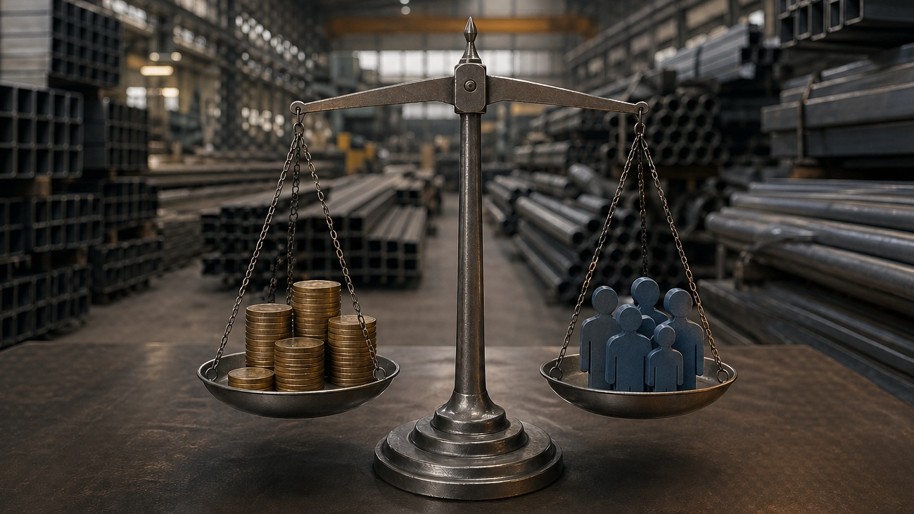
The debate on Belgium’s planned “centenindex”* directly affects the Belgian steel trade. Not only because labour costs are a major expense, but also because energy prices have a double impact in this sector: through higher bills and through automatic wage indexation.
Remarkably, employer organisations and trade unions are jointly asking the De Wever government to scrap the centenindex and replace it with an alternative. Such a common position is unusual, as both sides often disagree on wage and indexation matters.
What are employers and unions proposing?
Instead of a partial index jump, the social partners want energy prices to have a slower and less volatile impact on index calculations.
Specifically, they propose:
• calculating gas and electricity prices on the basis of an average over the past 12 months;
• taking into account not only new contracts but also ongoing fixed contracts;
• smoothing sudden spikes in energy prices.
According to them, this would make automatic wage indexation more stable and less sensitive to temporary shocks.
Why is the proposal criticised?
According to calculations by the Federal Planning Bureau and the NSSO, the proposal has three major drawbacks:
1. Less revenue for the government
De Tijd and L’Echo report that the alternative would generate around €352 million less than the centenindex by 2029.
2. Legal risks
As the proposal would apply only to the private sector, it could create unequal treatment between private- and public-sector workers.
3. Lower benefits and slower purchasing-power protection
Because the index would rise more slowly, lower benefits and pensions would also be adjusted later.
This makes it unlikely that the government will fully adopt the proposal.
What does this mean for steel traders in Belgium?
For the Belgian steel trade, this is more than a political discussion. It directly affects labour costs, energy prices, competitiveness and margins.
1. Labour costs remain crucial
When wages rise automatically through indexation, personnel costs increase. In a sector where margins are often tight, this weighs heavily.
2. Energy prices create a double cost impact
Steel traders feel energy prices in two ways:
• higher electricity and gas costs for warehouses, saw lines, machinery and logistics;
• higher wage costs when energy pushes the index upward.
3. Competition with neighbouring countries
Belgian steel traders compete daily with companies in the Netherlands, Germany, France and Luxembourg.
If Belgian labour costs rise faster than in neighbouring countries, competitiveness weakens.
4. Administrative simplicity also matters
Many companies point to the administrative complexity of the centenindex.
For SME steel traders without large HR departments, a simpler system is more attractive.
What can companies expect now?
In the short term, uncertainty remains. The government will decide in the coming months whether to:
• keep the centenindex;
• seek a compromise;
• reform the broader indexation mechanism.
The final decision could shape the cost structure of many Belgian steel traders for years to come.
*[The centenindex is a planned measure under which higher-paid employees would miss two 2% indexations on the part of their gross salary above €4,000. Certain benefits would also be partially limited.]